Showing posts with label temples. Show all posts

Saturday, August 18, 2012


ANNETTE'S TRAVELS: SOUTH INDIA, 2012 - ERNAKULAM AND KOZIKODE


We were disappointed in our day in Fort Kochin because our expectations were excessive and also perhaps because our rickshaw driver was more interested in taking us to shops - where he would get a cut from our purchases - than in showing us the sights. We therefore decided on the 17th of January to go to Ernakulam. We thought it would be an adventure to go to a large city without having preconceived notions of what we would be likely to encounter. As it happened, we were to have a fascinating day. To begin our day we took the hotel boat to the main jetty.

 View of the Harbour from the Hotel Boat

Main Jetty, Ernakulam


When we arrived, we asked a rickshaw driver to take us to the durbar hall art gallery, somewhere to begin rather than something expected to be special. The gallery was closed for renovation, but when we began to explore the area we discovered that the famous annual week-long Shiva temple festival was ending this very day and that by chance the temple we happened upon was in fact the Shiva temple where in a few hours the elephant procession would begin. We wandered about for a while and looked into some shops. 

Ernakulam Food Vendor

As we passed what looked to be the open entrance to a small hotel, I asked two children if they would allow me to take their photo. They agreed, and one of the adults standing beside us told me that a Brahmin wedding was being celebrated there. Just then, people began to descend a staircase a few metres to our left.  As I watched them coming down, I saw that among them were a man and a woman wearing garlands of flowers around their necks. These were obviously the bride and groom. When I raised my camera, they paused, smiling, to allow me to take my photograph. I felt greatly privileged. They were gracious and welcoming as are so many in India.

Brahmin Wedding, Ernakulam

We inquired at the police assistance booth and discovered that the procession of elephants would begin at the temple and travel for its conclusion to a large field nearby. Though it would be a while before the procession began, we decided to go to the field to see what was happening. People were already gathering, and we were lucky to find two of the last available seats. Next to us was an interesting man with whom we spent the next two hours or so. He spoke, for example, about his job as an able seaman on cargo ships, including his last post on an oil tanker out of Panama. He described the big storms that had frightened him. He lived in Alleppey, spending ten months of the year away and the remainder at home with his wife and two children.


He was in Ernakulam to attend the annual seven-day Makaravilakku festival in the Periyar tiger preserve. He explained that pilgrims went there because every year on the same day a bright light was seen ascending three times up into the sky. He believed this was the work of the god Ayappa who resided in the temple there. Paul later read in the newspaper, however, that this was a hoax. Because the 200,000 devotees bring in a lot of revenue for the temple every year, the state of Kerala has allowed the festival to be held in the tiger preserve. To protect the tigers, however, no lighting ha been provided. This year, after a jeep overturned in the dark and rolled down a hill, the resulting  stampede caused 102 deaths. Without any lighting, the police were unable to locate and assist the injured. Although a similar though less serious accident had occurred some years previously, the state government had refused to deal with the conflict between the temple and the tiger reserve.

Our friend told us about pilgrimages and festivals.  Most pilgrims are men because women between the ages of ten and 50 women are not allowed in the temple. They will light a flame at home, but are considered unclean during their monthly period. Some will not even cook at this time. Pilgrims fast for 41 days during the pilgrimage he attended. They pray at 6:30 p.m., because this is when the god is believed to be most potent and capable of answering supplicants' prayers.

More and more people were coming into the large field where we were sitting. Finally, we heard what sounded like drums and bugles. I moved closer to the road where I could see ten or fifteen men begin to dance to the music dressed in elaborately decorated red and white outfits, each holding a cymbal. They were accompanied by drummers.


It sounded like martial music, with dancing that was stylized to resemble fighting. The hypnotic performance went on and on, the repetitions of the dance keeping time with the loud rhythms of the music.


Soon, six beautifully decorated elephants arrived, one behind the other. 


The atmosphere was incredibly intense: obviously this was an event of high significance.The elephants moved slowly down the field and lined up horizontally, each standing with his mahout beside him. 

 
Increasing numbers of people were arriving.


With so many people in an enclosed space with only one visible exit, we became uncomfortable and decided to leave.


Musicians We Passed on Our Way Out of the Field

When we reached the road, we found it had been closed. Army and police were in evidence, but there was no sign of aggressive behaviour.

 Musicians on the Road


We walked a few blocks to where the road was open and got a rickshaw. The driver had to use many detours before he finally found a way to get out of the area. Every street was crowded with people walking to join the elephants. Not being accustomed to large crowds, we were relieved to have made an exit; but what an experience!

Next day, January 18th, we took the train to Calicut (Kozhikode), arriving in the evening about nine o'clock, then going by rickshaw to our hotel, the Taj Gateway. This was a luxury hotel with a beautiful swimming pool.  We decided to have a lazy day on the 19th, reading and drinking diet Coke at the pool.

On January 20th we went to Coimbatore by train and then by taxi to Mettupalayan, arriving late afternoon. After a night in a hotel there, we would take the old steam train to Ooty.

NOTE:  If you would like to view a photo full screen, right-click on it and then click on "View Link in a New Window".  To return to the blog, click on the x.


Monday, August 13, 2012


ANNETTE'S TRAVELS: SOUTH INDIA 2012 - KOCHIN


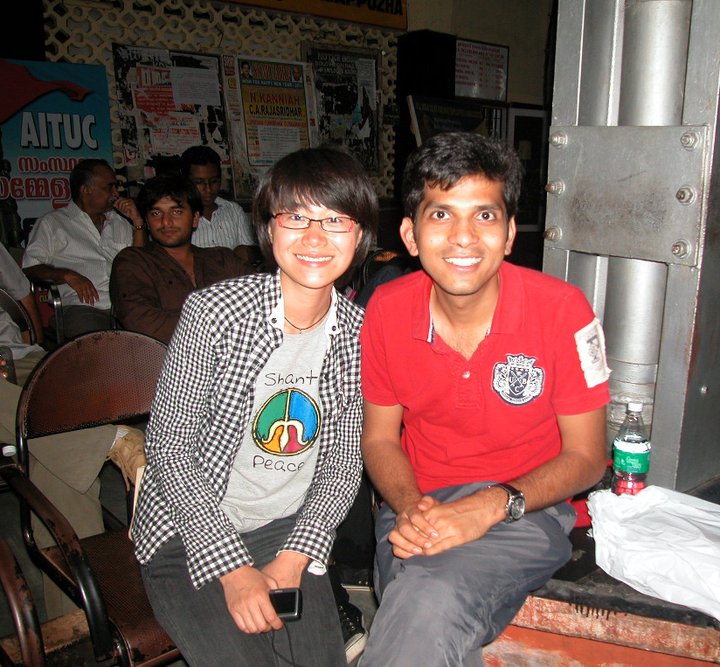
When we arrived in Alleppey we went to the station and waited for the Ernakulam train which was scheduled to leave at around 8:00 pm but turned out to be 90 minutes late. During our wait we had a very enjoyable conversation with two young people who were employees of Intel, a young woman from China and a young man from the eastern part of India. They were both working on software development for mobile phones. They had met in China when the young man was sent there by Intel for five months to help set up a new work unit. Now, the young woman was given the opportunity for two months of on-the-job training in India. What was striking about these two was their intelligence and engaging personalities. We were very impressed by them and enjoyed their company. Before we knew it, the 90 minutes had passed and our train had arrived.


We disembarked at Ernakulam only to find that hundreds of men dressed entirely in black were lying on the platform in the darkness as if bedded down for the night. It's a large station with a very long platform. There were enough men lying about to almost completely cover the available space, leaving barely enough room for us to pull our suitcases through. The number of people was intimidating, and the meager lighting didn't help.

I wasn't afraid of violence, but when the train pulled out, I was worried that one of us would by accident be pushed off the edge of the platform and fall down onto the tracks below. We were looking for the exit but didn't know where it was. After what seemed like hours but was actually no more than twenty minutes or so, we saw the station exit sign and then made our way to our hotel, safe but very stressed and tired. Later, we discovered that the crowds of men in the station were devotees at the temple located in the Periyar game preserve. They were among the estimated 200,000 pilgrims who were visiting there for the annual festival.

In order to reach our hotel it was necessary to cross a long bridge and take a very rough road in the dark. The hotel, the Bolgatty Palace, is located between Fort Kochi and Ernakulam on Bolgatty Island. The grounds were beautifully lit up with dozens of tiny bright blue lights and our room was lovely. 

T
The Bolgatty Palace Hotel

 The Grounds of our Hotel Looking towards Kochi

Next morning, January 16th, we took the hotel boat across the harbour to the Fort Kochin government boat jetty. Modern buildings lined the harbour.  As on almost every day of this trip, the sun shone brilliantly. The sky was an intense blue; the water in the harbour sparkled.

 View from our Hotel towards Ernakulam, the Urban Part of Kochin

Soon after we disembarked we were approached by Babu, a handsome young rickshaw driver, who offered to take us around Fort Kochin. First, we stopped to see a procession that had originated from a small temple nearby.  It included one elephant, elaborately decorated for the harvest festival, and a few musicians, one with a horn and several with drums. They stopped only momentarily before continuing down a narrow street to the temple. We were happy because we very much wanted to see a temple procession with elephants. The elephant symbolizes good fortune in India.  Ganesh, the god of good fortune, takes the form of an elephant.

 The Procession Approaches Us


Procession Moves towards the Temple
 
Babu took us to see St. Francis church, and then the Chinese fishing nets and fish market at Vasco de Gama Square. 

Chinese Fishing Nets

 Vasco de Gama Square

He then took us to an excellent shop to look for gifts to take home. Finally, he dropped us off for lunch at Brunton's Boat Yard, an upscale restaurant in a beautiful traditional building on the harbour.

 Restaurant where We Met Bryan Pearson

Soon after, a man about my age sat down at an adjacent table. We asked where he was from, and when he said "Canada" we asked if he was traveling alone and would he like to join us. It turned out that his name was Bryan Pearson from Iqaluit on Baffin Island in the NWT. He had gone to northern Canada as a young man to work on the DEW line, and, as it sometimes happens, never left the North. For several years he had been the mayor if Iqaluit and then an elected member of the legislature.

We had a thoroughly enjoyable time with him over the next hour or so, talking about municipal politics and sharing stories of our travels. His most noteworthy trips were on an African safari and, in the 1980's, on a long trip down the Mekong River in a small boat. His current trip to India had a very tragic association: in 2009 he had canceled a planned Indian vacation with two good friends. They went on the vacation without him, and were both killed in the Taj Hotel terrorist attack in Mumbai.

That evening we saw a Kathakali performance at a small theatre in our hotel. This is a traditional dance form in which folk tales are set to music. The first part of the performance consisted of the dancer lying on his back and, with the help of a small mirror, applying brightly coloured paints to his face in a pattern that gave him a fierce appearance. 

 Dancer Applying his Make-Up

Having completed his preparations, he left the stage to put on his costume.  A singer who played the cymbals and a drummer appeared. Their part of the performance consisted of an explanation of the story that would be expressed in the kathakali dance itself which formed the third and final part.

Soon the dancer reappeared. He wore an elaborate brass headdress and a short but very wide skirt.  He danced for about half an hour to the accompaniment of the drum and cymbal and some loud wailing and chanting on the part of the cymbal player. The dancer was barefoot, and didn't move about the stage much at all. Instead, he told the story through an elaborate series of hand and eye movements accompanied by constantly changing facial expressions.  All of these appeared to have very specific meanings in relation to the story.


We were the only audience. At the conclusion of the performance we were each asked to contribute the equivalent of five dollars in rupees.

The next day, January 17th, we spent in Ernakulam.

NOTE: If you would like to see the photos in full screen, right-click on the photo and then on "View Link in a New Window". To return to the blog, close the page by clicking on the x.


Thursday, February 11, 2010

TRAVEL THE WORLD - BIKANER, INDIA


This Jain temple in Bikaner, Rajasthan was photographed in 2007. Jainism, one of India's major religions, is very old. Its adherents are especially known for the respect they have for all life to the extent that they will not even kill an insect. In most communities, Jains operate shelters for abandoned or ill animals. Though each Jain temple was unique, this temple had the beautiful decoration we had come to expect. We were amazed to be allowed to approach the inner sanctum featured in the second photo. This is the most holy part of the temple, where the image of the god is seen and worshiped.

Saturday, February 6, 2010

TRAVEL THE WORLD - SELINUNTE, SICILY


Here is another photo taken in 2000 of a beautiful Greek temple at Selinunte in Sicily. As in several other temples in Sicily, we were are able to walk directly into the temple itself, something we had never been able to do before. Like all Greek temples, one of its most striking features is its having been posiioned within the landscape in a way that enhances its beauty and fine proportions.

TRAVEL THE WORLD - AGRIGENTO, SICILY


A wonderful part our Sicily vacation in 200 was to see the many ancient Greek temples. The island has more of these - and in a better state of preservation - than anywhere I know of outside Greece itself. The temple in the photo is located near Agrigento where there are extensive ruins.

Tuesday, February 2, 2010

TRAVEL THE WORLD - MAHESHWAR, INDIA


Maheshwar, located on the Narmada River in Madhya Pradesh, is not on the itinerary of very many tourists as there is no rail service. It took twelve hours with a car and driver to reach our destination from Indore. The roads were very rough, but were being improved - a good thing, as Maheshwar and the surrounding area are well worth a visit. Within the Holkar dynasty fort there are several temples with wonderful stone carvings dating from the 17th Century. These photos, taken in 2007, give two examples.

Monday, January 18, 2010

TRAVEL THE WORLD - ABU SIMBEL, EGYPT


The smaller of the two temples at Abu Simbel, photographed in 2004, was built by Ramesses II to honor both Hathor as the goddess of love and music and his wife Nefertari as the deified queen.

Monday, November 30, 2009

TRAVEL THE WORLD - SIDE, TURKEY


When we visited Turkey in 2001, we went to Side to see the ancient ruins including the Roman Temple of Apollo featured in the photo above. We were disappointed in Side, because of the way modern development had been allowed to encroach on the ruins. This temple bathed in light at sunset was very nice. We stopped here for a while and had a long chat with a young couple from Vancouver. They were very upset about an expensive Turkish carpet they had purchased and then asked the shopkeeper to ship home for them. When it arrived, there was a $400 duty charge to be paid. This was refused by the husband's mother who returned the carpet to the shop in Istanbul. The young people were on their honeymoon, and now had to return to the shop in Istanbul to hopefully sort things out. We realized how fortunate we were that our own carpet had arrived home safely without duty charges, but we had no idea what had made the difference.

Wednesday, November 4, 2009

TRAVEL THE WORLD - AURANGABAD, INDIA


These 2007 photos were taken in front of and inside a Jain temple in Aurangabad in Maharashtra. Jainism is an ancient religion which regards every living thing as potentially divine and therefore to be protected. Jains seek to attain spiritual enlightenment through the practice of non-violence and through cultivating wisdom and self-control. Jainism is thought to have influenced Bhuddism and Hinduism in ancient times. The religion, which has between 10 and 12 million followers, is held in high esteem in India. Jain temples contain beautifully intricate stone carvings, and most towns have a Jain animal shelter. In the second photo above a man is making an offering in the temple.

Wednesday, October 28, 2009

TRAVEL THE WORLD - AGRIGENTO, SICILY


At Agrigento in 2000, as elsewhere in Sicily, we were able to walk freely among the ancient ruins, something that made it possible to appreciate these beautiful sites in a new way. The city of Agrigento was nothing special, but near it there were several Greek temples to wander about in. These have been designated a World Heritage Site and date from the 6th and 5th Centuries B.C.

Monday, October 26, 2009

TRAVEL THE WORLD - MAHESHWAR, INDIA


Maheshwar, in Madhya Pradesh, is a very attractive town on the Narmada River. Here is one of several 17th Century temples located there. If you enlarge the photo, you will be able to see examples of the lovely carving that embellish the buildings at Maheshwar. When we visited the town in 2007, we had a very enjoyable walk beside the ghats on the beautiful river.

Tuesday, September 22, 2009

TRAVEL THE WORLD - KOM OMBO, EGYPT


The photo was taken in 2004 in the temple of Kom Ombo, located about 50 kilometers north of Aswan. Horus, shown on the left, is the Egyptian god of the sky and of war. He was one of the most significant of the gods. On the right is Hathor, protector of women and goddess of feminine love, motherhood and joy. She was one of the most popular gods. The temple dates from the 2nd Century BC. It is very interesting when visiting Egypt to hear of the ancient religion and the many stories about the various gods.

Monday, September 14, 2009

TRAVEL THE WORLD - ABU SIMBEL, EGYPT

The great temple of Ramesses II at Abu Simbel was one of the many amazing and impressive things we saw in Egypt in 2004. Two huge temples were cut out of the sandstone cliff in the 13th Century BC during the reign of Ramsses II as a demonstration of his power and divine nature. The statues in the photo stand 20 meters in height. Equally impressive is what was achieved during the 1960's. UNESCO mounted an international effort in which the entire temple complex was moved to higher ground in order to escape the rising waters of the Nile following the construction of the Aswan high dam.

Monday, September 7, 2009

TRAVEL THE WORLD - SEGESTA, SICILY

In 2000, we traveled to Sicily and were very pleasantly surprised when we saw its beautiful ancient temples. This Doric temple was built in the late 5th Century BC when Segesta was one of several Greek cities that existed on the island.

Thursday, September 3, 2009

TRAVEL THE WORLD - ATHENS


For more than 20 years, my husband, Paul, and I have traveled the world. We've visited Europe, Asia, Africa and North America.

Why do we travel? Mainly it's because of our interest in people - their history, culture, architecture, art, their achievements and their challenges. Starting today, I will begin to post the highlights of these vacations.

The first photo - I think very appropriately - is of the Parthenon in Athens taken in 1998. I first saw the Parthenon in 1984 and was filled with anticipation on the climb up to see it. It is perhaps the most significant site in all the world, not only for its pure beauty but also because it symbolizes all that we admire in the ancient Greeks - their mathematics and science, their respect for the individual, their practice of democracy, their attempts to understand the human condition, and the classical beauty of their architecture, vase painting and sculpture.

Friday, December 19, 2008

INDIA VACATION 2007


JAIN TEMPLES IN INDIA


Jainism, an ancient religion, has 10 million followers in India. Compassion for all life is central to their beliefs. They adhere to a vegetarian or vegan diet, and almost every town and village in India has its Jain animal shelter.

Ranakpur temple, located 60 km from Udaipur in Rajasthan, is famously said to contain 1,400 carved marble columns, all different. Dating the temple is controversial, but there is agreement that it was built between the late-14th and mid-15th centuries. Ranakpur temple is pictured in the first photo above.

Another Jain temple, the Bhandashah temple, shown in the second photo, is the oldest structure in Bikaner. It dates from the year 1514.

Wednesday, December 17, 2008

INDIA VACATION 2007


MAHESHWAR ON THE NARMADA RIVER

Maheshwar, located on the Narmada River, is not on the itinerary of very many tourists as there is no rail service. It took twelve hours with a car and driver to reach our destination from Indore. The roads were very rough, but were being improved - a good thing, as Maheshwar and the surrounding area are well worth a visit. Within the Holkar dynasty fort there are several temples with wonderful carvings dating from the 17th Century. One example is shown in the first photo above.

As we strolled by the beautiful Narmada River, we were greeted joyfully by several women from Goa who welcomed us to India and invited us to visit them. Some of them are shown in the second photo above.