skip to main |
skip to sidebar
 Hagia Sophia is a familiar landmark of Istanbul. The cathedral was built by the Byzantine emperor Justinian between 532 and 537 and is considered the prime example of Byzantine architecture. It is famous for its huge dome. After Byzantium was conquered by the Ottoman Turks in 1453, the city became Muslim and Hagia Sophia became a mosque. It was very dark inside. My main impression was of its immense size and the incredible height of the roof. There are some beautiful mosaics as well. I believe it has now become a museum.
 Vannes is a very old city, originally founded by the Romans. It has an old world charm which we found particularly appealing. Our visit was in 2008.

 These photographs, taken at Amber Fort near Jaipur in 2007, are yet more evidence of the beauty of Islamic architecture and design. The second photo shows the exterior of the Jai Mandir, and the first is taken in the Sheesh Mahal or Hall of Mirrors which is inside the building.
 Here is another photo taken in 2000 of a beautiful Greek temple at Selinunte in Sicily. As in several other temples in Sicily, we were are able to walk directly into the temple itself, something we had never been able to do before. Like all Greek temples, one of its most striking features is its having been posiioned within the landscape in a way that enhances its beauty and fine proportions.
 A wonderful part our Sicily vacation in 200 was to see the many ancient Greek temples. The island has more of these - and in a better state of preservation - than anywhere I know of outside Greece itself. The temple in the photo is located near Agrigento where there are extensive ruins.

 In 1984, my mother and I had a holiday in England. One of the best things we did was to visit Salisbury cathedral. A nice man who was a very knowledgeable volunteer spent an hour or so taking us around to explain the wonders of the cathedral. The second photo shows the cathedral cloisters, while the first features the cathedral itself.
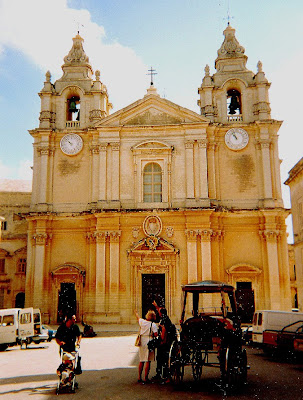 Mdina, the old capital of Malta, is a medieval walled town. We spent a day walking there in 2000 admiring the many old buildings like the church in the photo. Mdina appeared not to have changed at all since medieval times. There were many narrow streets and only a few people.

 Maheshwar, located on the Narmada River in Madhya Pradesh, is not on the itinerary of very many tourists as there is no rail service. It took twelve hours with a car and driver to reach our destination from Indore. The roads were very rough, but were being improved - a good thing, as Maheshwar and the surrounding area are well worth a visit. Within the Holkar dynasty fort there are several temples with wonderful stone carvings dating from the 17th Century. These photos, taken in 2007, give two examples.

 The cathedral of Bayeux, photographed in 1997, is a fine example of the many wonderful Gothic cathedrals of France. Bayeux itself is also famous for the Bayeux tapestry which is located in a special museum in the city. The tapestry is an embroidered cloth depicting the events leading up to the Norman conquest of England and the invasion itself. It is beautiful and very interesting.
 This photo was taken in 1997 during my second visit to Wells Cathedral, but my first when there was no scaffolding on the front, making it possible to see the beautiful sculptured figures. The interior is splendid and has the famous inverted arch. Of all the medieval cathedrals I've visited, this is the one I most admire.
 This mosque, the Jama Masjid in Old Delhi, is one of the largest in India. It was commissioned by the Mughal Emperor Shah Jahan and completed in the year 1656. It is located near the entrance to Chandni Chowk, a very busy and popular market center in Old Delhi. The mosque has three gateways, four angle towers and two 40-meter-high minarets. Tourists can enter the mosque if they take off their shoes and are properly dressed. It is also possible to climb to the top of the minarets. The courtyard can hold up to twenty-five thousand worshippers. The mosque houses important relics including a copy of the Qur'an written on deer skin.

 After Montpellier, our favourite small city in France is Blois, which is located on the Loire river, featured in the second photo taken in 1999. The 16th Century Hotel d'Alluye, in the first photo, is a beautiful example of French Renaissance architecture.
 This very fine Romanesque building, the Abbaye des Hommes in Caen, was built in the 11th Century from local stone.

 These two beautiful buildings in Toulouse were photographed in 1999. The first is the Hotel d'Assezat, the first Renaissance structure in the city, and the second is the Basillic St. Simon.
 This circle of 30 houses, photographed in 1984, is a very famous example of 18th Century innovation in British architecture. It was planned and developed by the Prince Regent, hence its name, the Royal Crescent. The architect was John Wood the Younger.