Showing posts with label hinduism. Show all posts

Saturday, August 18, 2012


ANNETTE'S TRAVELS: SOUTH INDIA, 2012 - ERNAKULAM AND KOZIKODE


We were disappointed in our day in Fort Kochin because our expectations were excessive and also perhaps because our rickshaw driver was more interested in taking us to shops - where he would get a cut from our purchases - than in showing us the sights. We therefore decided on the 17th of January to go to Ernakulam. We thought it would be an adventure to go to a large city without having preconceived notions of what we would be likely to encounter. As it happened, we were to have a fascinating day. To begin our day we took the hotel boat to the main jetty.

 View of the Harbour from the Hotel Boat

Main Jetty, Ernakulam


When we arrived, we asked a rickshaw driver to take us to the durbar hall art gallery, somewhere to begin rather than something expected to be special. The gallery was closed for renovation, but when we began to explore the area we discovered that the famous annual week-long Shiva temple festival was ending this very day and that by chance the temple we happened upon was in fact the Shiva temple where in a few hours the elephant procession would begin. We wandered about for a while and looked into some shops. 

Ernakulam Food Vendor

As we passed what looked to be the open entrance to a small hotel, I asked two children if they would allow me to take their photo. They agreed, and one of the adults standing beside us told me that a Brahmin wedding was being celebrated there. Just then, people began to descend a staircase a few metres to our left.  As I watched them coming down, I saw that among them were a man and a woman wearing garlands of flowers around their necks. These were obviously the bride and groom. When I raised my camera, they paused, smiling, to allow me to take my photograph. I felt greatly privileged. They were gracious and welcoming as are so many in India.

Brahmin Wedding, Ernakulam

We inquired at the police assistance booth and discovered that the procession of elephants would begin at the temple and travel for its conclusion to a large field nearby. Though it would be a while before the procession began, we decided to go to the field to see what was happening. People were already gathering, and we were lucky to find two of the last available seats. Next to us was an interesting man with whom we spent the next two hours or so. He spoke, for example, about his job as an able seaman on cargo ships, including his last post on an oil tanker out of Panama. He described the big storms that had frightened him. He lived in Alleppey, spending ten months of the year away and the remainder at home with his wife and two children.


He was in Ernakulam to attend the annual seven-day Makaravilakku festival in the Periyar tiger preserve. He explained that pilgrims went there because every year on the same day a bright light was seen ascending three times up into the sky. He believed this was the work of the god Ayappa who resided in the temple there. Paul later read in the newspaper, however, that this was a hoax. Because the 200,000 devotees bring in a lot of revenue for the temple every year, the state of Kerala has allowed the festival to be held in the tiger preserve. To protect the tigers, however, no lighting ha been provided. This year, after a jeep overturned in the dark and rolled down a hill, the resulting  stampede caused 102 deaths. Without any lighting, the police were unable to locate and assist the injured. Although a similar though less serious accident had occurred some years previously, the state government had refused to deal with the conflict between the temple and the tiger reserve.

Our friend told us about pilgrimages and festivals.  Most pilgrims are men because women between the ages of ten and 50 women are not allowed in the temple. They will light a flame at home, but are considered unclean during their monthly period. Some will not even cook at this time. Pilgrims fast for 41 days during the pilgrimage he attended. They pray at 6:30 p.m., because this is when the god is believed to be most potent and capable of answering supplicants' prayers.

More and more people were coming into the large field where we were sitting. Finally, we heard what sounded like drums and bugles. I moved closer to the road where I could see ten or fifteen men begin to dance to the music dressed in elaborately decorated red and white outfits, each holding a cymbal. They were accompanied by drummers.


It sounded like martial music, with dancing that was stylized to resemble fighting. The hypnotic performance went on and on, the repetitions of the dance keeping time with the loud rhythms of the music.


Soon, six beautifully decorated elephants arrived, one behind the other. 


The atmosphere was incredibly intense: obviously this was an event of high significance.The elephants moved slowly down the field and lined up horizontally, each standing with his mahout beside him. 

 
Increasing numbers of people were arriving.


With so many people in an enclosed space with only one visible exit, we became uncomfortable and decided to leave.


Musicians We Passed on Our Way Out of the Field

When we reached the road, we found it had been closed. Army and police were in evidence, but there was no sign of aggressive behaviour.

 Musicians on the Road


We walked a few blocks to where the road was open and got a rickshaw. The driver had to use many detours before he finally found a way to get out of the area. Every street was crowded with people walking to join the elephants. Not being accustomed to large crowds, we were relieved to have made an exit; but what an experience!

Next day, January 18th, we took the train to Calicut (Kozhikode), arriving in the evening about nine o'clock, then going by rickshaw to our hotel, the Taj Gateway. This was a luxury hotel with a beautiful swimming pool.  We decided to have a lazy day on the 19th, reading and drinking diet Coke at the pool.

On January 20th we went to Coimbatore by train and then by taxi to Mettupalayan, arriving late afternoon. After a night in a hotel there, we would take the old steam train to Ooty.

NOTE:  If you would like to view a photo full screen, right-click on it and then click on "View Link in a New Window".  To return to the blog, click on the x.


Monday, August 13, 2012


ANNETTE'S TRAVELS: SOUTH INDIA 2012 - KOCHIN


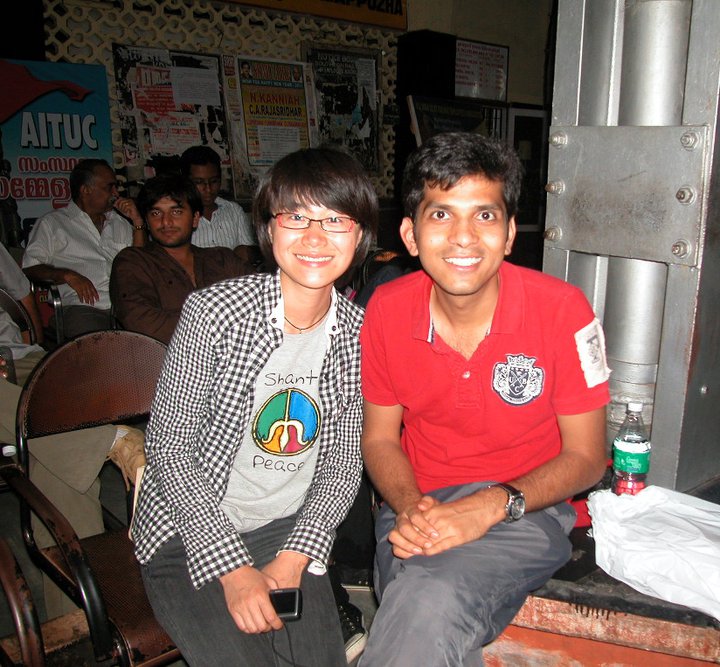
When we arrived in Alleppey we went to the station and waited for the Ernakulam train which was scheduled to leave at around 8:00 pm but turned out to be 90 minutes late. During our wait we had a very enjoyable conversation with two young people who were employees of Intel, a young woman from China and a young man from the eastern part of India. They were both working on software development for mobile phones. They had met in China when the young man was sent there by Intel for five months to help set up a new work unit. Now, the young woman was given the opportunity for two months of on-the-job training in India. What was striking about these two was their intelligence and engaging personalities. We were very impressed by them and enjoyed their company. Before we knew it, the 90 minutes had passed and our train had arrived.


We disembarked at Ernakulam only to find that hundreds of men dressed entirely in black were lying on the platform in the darkness as if bedded down for the night. It's a large station with a very long platform. There were enough men lying about to almost completely cover the available space, leaving barely enough room for us to pull our suitcases through. The number of people was intimidating, and the meager lighting didn't help.

I wasn't afraid of violence, but when the train pulled out, I was worried that one of us would by accident be pushed off the edge of the platform and fall down onto the tracks below. We were looking for the exit but didn't know where it was. After what seemed like hours but was actually no more than twenty minutes or so, we saw the station exit sign and then made our way to our hotel, safe but very stressed and tired. Later, we discovered that the crowds of men in the station were devotees at the temple located in the Periyar game preserve. They were among the estimated 200,000 pilgrims who were visiting there for the annual festival.

In order to reach our hotel it was necessary to cross a long bridge and take a very rough road in the dark. The hotel, the Bolgatty Palace, is located between Fort Kochi and Ernakulam on Bolgatty Island. The grounds were beautifully lit up with dozens of tiny bright blue lights and our room was lovely. 

T
The Bolgatty Palace Hotel

 The Grounds of our Hotel Looking towards Kochi

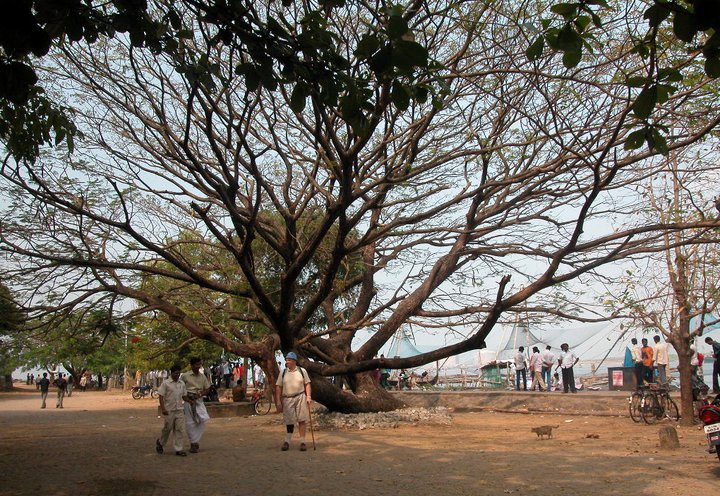
Next morning, January 16th, we took the hotel boat across the harbour to the Fort Kochin government boat jetty. Modern buildings lined the harbour.  As on almost every day of this trip, the sun shone brilliantly. The sky was an intense blue; the water in the harbour sparkled.

 View from our Hotel towards Ernakulam, the Urban Part of Kochin

Soon after we disembarked we were approached by Babu, a handsome young rickshaw driver, who offered to take us around Fort Kochin. First, we stopped to see a procession that had originated from a small temple nearby.  It included one elephant, elaborately decorated for the harvest festival, and a few musicians, one with a horn and several with drums. They stopped only momentarily before continuing down a narrow street to the temple. We were happy because we very much wanted to see a temple procession with elephants. The elephant symbolizes good fortune in India.  Ganesh, the god of good fortune, takes the form of an elephant.

 The Procession Approaches Us


Procession Moves towards the Temple
 
Babu took us to see St. Francis church, and then the Chinese fishing nets and fish market at Vasco de Gama Square. 

Chinese Fishing Nets

 Vasco de Gama Square

He then took us to an excellent shop to look for gifts to take home. Finally, he dropped us off for lunch at Brunton's Boat Yard, an upscale restaurant in a beautiful traditional building on the harbour.

 Restaurant where We Met Bryan Pearson

Soon after, a man about my age sat down at an adjacent table. We asked where he was from, and when he said "Canada" we asked if he was traveling alone and would he like to join us. It turned out that his name was Bryan Pearson from Iqaluit on Baffin Island in the NWT. He had gone to northern Canada as a young man to work on the DEW line, and, as it sometimes happens, never left the North. For several years he had been the mayor if Iqaluit and then an elected member of the legislature.

We had a thoroughly enjoyable time with him over the next hour or so, talking about municipal politics and sharing stories of our travels. His most noteworthy trips were on an African safari and, in the 1980's, on a long trip down the Mekong River in a small boat. His current trip to India had a very tragic association: in 2009 he had canceled a planned Indian vacation with two good friends. They went on the vacation without him, and were both killed in the Taj Hotel terrorist attack in Mumbai.

That evening we saw a Kathakali performance at a small theatre in our hotel. This is a traditional dance form in which folk tales are set to music. The first part of the performance consisted of the dancer lying on his back and, with the help of a small mirror, applying brightly coloured paints to his face in a pattern that gave him a fierce appearance. 

 Dancer Applying his Make-Up

Having completed his preparations, he left the stage to put on his costume.  A singer who played the cymbals and a drummer appeared. Their part of the performance consisted of an explanation of the story that would be expressed in the kathakali dance itself which formed the third and final part.

Soon the dancer reappeared. He wore an elaborate brass headdress and a short but very wide skirt.  He danced for about half an hour to the accompaniment of the drum and cymbal and some loud wailing and chanting on the part of the cymbal player. The dancer was barefoot, and didn't move about the stage much at all. Instead, he told the story through an elaborate series of hand and eye movements accompanied by constantly changing facial expressions.  All of these appeared to have very specific meanings in relation to the story.


We were the only audience. At the conclusion of the performance we were each asked to contribute the equivalent of five dollars in rupees.

The next day, January 17th, we spent in Ernakulam.

NOTE: If you would like to see the photos in full screen, right-click on the photo and then on "View Link in a New Window". To return to the blog, close the page by clicking on the x.


Wednesday, August 8, 2012

ANNETTE'S TRAVELS: SOUTH INDIA IN 2011 - KANYAKUMARI
  
On January 6th we went from Kodaikanal to Kanyakumari which is located at the southernmost tip of India where the Bay of Bengal, Arabian Sea and Indian Ocean come together. First, we had Raja drive us from the mountains down to Madurai, a two-and-a-half-hour trip. Then we went by train to Nagercoil Junction, arriving around 10:00 p.m.  With no other people around, we walked in the dark to the parking lot and fortunately found a taxi.  

We then had a half-hour drive to the Sea Face hotel in Kanyakumari. The entrance didn't impress, so we went up to look at the room, our taxi driver waiting for us.  It was by far the most horrible hotel I had ever seen. The men at reception did not appear to be surprised by our reaction, and simply suggested that we go to the Sea View hotel next door. It was late at night by now, but we felt we had no option but to roll our suitcases a couple of hundred yards up a hill to the other hotel and take our chances, feeling a bit reassured that at least our driver would be there for us if we needed him.

The hotel looked great, and we couldn't believe our luck when we were given a room.  Then we asked ourselves how on earth had we managed to book such a crummy hotel when all our hotel reservations were based on online photos and reviews.  Next day, we investigated and saw to our amazement that the Internet photos used by first awful hotel were actually photos of the second beautiful hotel. We reported this at reception and were told that both hotels were owned by the same person but were under two different managers who were enemies. So go figure!

Kanyakumari is a nice town of around 35,000 people. Next morning, January 7th, the day after our arrival, we were surprised not to see the thousands of pilgrims we were told to expect. We decided to spend the day exploring the town, leaving a visit to see the island memorials for the next day.

By evening people were beginning to arrive for the weekend. These thousands were coming to see the statue of St. Thiruvalluvar and the Vivekinanda Rock Memorial which are located on two islands just offshore. Our plan for the next day was to take the ferry that shuttles people to and fro and to beat the crowds by having an early start.

 The Kanyakumari Ghats

In keeping with our plan we got up early, left the hotel at 7:30 a.m. and began to walk towards the ferry only to discover that the streets were choked with people. We were dismayed to find the queue already more than a mile long. Estimated time of arrival at the ferry was four hours. I was still getting over a cold so we decided not to go. In any case, good photos were possible from the shore.

 The statue of St. Thiruvalluvar and the Vivekinanda Rock Memorial 

The crowds we encountered here made us aware that we were having a hard time getting used to being constantly surrounded by people in the streets, on the highways, in the stations, in the shops, in the villages, virtually everywhere. At first it was intimidating, but gradually we began to feel quite safe. We did have a need occasionally to find a refuge from the noise, smells, squalor and pollution, however. We found it by relaxing over a long lunch in the restaurant of a luxury hotel. This is undoubtedly one of the best bargains India has to offer western tourists.

My most memorable experience in Kanyakumari was at the 1000-year-old Guganathaswamy temple. Paul stayed outside rather than having to take off his shoes. I went in and was motioned into the inner sanctum where the temple Brahmin handed me a brass dish holding oil burning with a large flame. I went to take it from him, but he held it back and moved his hand over the flame and then over his face. Not sure what was expected, I then did the same. 

Now, he held out some milky liquid, which I took in my hand and patted onto my face. He said, "No, drink" so I took a few drops. Finally, he put ashes and some dark orange-coloured paste on my forehead. When he passed a large plate with flowers and rupees on it, I put down some money. The other person in the inner sanctum with me, a Hindu lady, told me to take some flowers outside for the cows in the garden. It was a strange and  moving experience.

 Temple Entrance

 In the Grounds of the Temple

 Offerings in the Temple Grounds

Not feeling very energetic, we took it easy in Kanyakumari. First, we visited the Catholic church which dated from the time of St. Francis Xavier in the 17th Century.

 Our Lady of Ransom Church

  Church Interior

We also went to see the Suchindram temple located a few kilometers from the town. 

 Suchindram Temple Tank

 Close-Up View of the Tank

 Typical Rural Landscape around Kanyakumari

The town ghats were where we spent most of our time. This is an attractive area that is a major focus of activity for the town. We spent hours there watching the people.  While we were sitting on the edge of the platform that surrounded a small temple, we were approached by two beautiful young Muslim women. 

Beautiful!

Left side is the Bay of Bengal, Middle is the Indian Ocean, and Right side, the Arabian sea more


One remarkable aspect of our hotel, apart from its relative luxury, was that, in spite of being in Tamil Nadu - a dry state - it had a bar. This was located on the basement level and was very poorly lit. We had dinner there each night in order enjoy the Indian Kingfisher beer. Although dark and gloomy, it was an attractive room. Nonetheless,  barely able to see the folks at adjacent tables, we thought the atmosphere resembled a speakeasy during prohibition.

From Kanyakumari we left Tamil Nadu for Trivndrum and Varkala in the state of Kerala. Having rounded the southern tip of India, we would now be traveling in a northerly direction.

NOTE ON THIS BLOG: to see full-screen photos, right click on a photo and then on "Open this link in a new window".  To return to the blog, click on the x to close the page.

Saturday, August 4, 2012


TRAVEL THE WORLD:  INDIA IN 2011: CHENNAI AND MADURAI


Early on January 1st, we hired a car and driver to take us from Kanchipuram to Chennai, a trip that wasn't possible by train. Our plan was that we would take an overnight train that evening from Chennai to Madurai to see the huge Meenakshi temple. We decided to leave our suitcases at the Accord Metropolitan Hotel for the day while we attended the Chennai Dance and Music Festival which was held annually from mid-December until mid-January.

 Lobby of the Accord Metropolitan Hotel

We inquired about the music festival, which is huge, and were very disappointed to discover that, this being New Year's Day, no concerts were scheduled. Having seen a wonderful performance of Indian classical dance in Mamallapuram, we were very eager to see more. Instead, we spent the day at the hotel, enjoying our surroundings and the good food, and catching up on the outside world at the hotel's Business Centre.  Shortly after dinner we took a taxi to the station to catch our train.

Taking an overnight train in India is a very pleasant and inexpensive experience. We normally booked an upper and lower bunk bed in an air conditioned coach. Our fellow travelers almost invariably spoke English and were very friendly and helpful. On each side of the compartment there will be an upper and a lower bed complete with clean sheets and a reading light. We were a bit nervous about sharing a compartment with strangers, but, after taking many overnight trains, this had never been a problem. Heavy dark green curtains screen you from the corridor, providing adequate privacy. By around 10 p.m. everything becomes quiet except for the clack-clack of the wheels. The soothing motion of the train quickly puts you to sleep.

The places we visited in the state of Tamil Nadu were dusty and dirty. You have to look the other way and try not to notice the rubbish beside the road. Madurai, a city of about two million, was a good example.  

To see the photos in full screen size, right-click on the photo and then click on "Open Link in New Window".  Close the page in order to return to the blog.

 People Making their Way to the Meenakshi Temple

 Madurai Tailor
 Madurai Coconut Vendor

Madurai's main attraction is a large and famous temple - the Meenakshi - that covers 45 acres. It has fourteen huge towers which are covered with colourful plaster carvings to illustrate stories of the gods Shiva and Parvati, to whom the temple is dedicated. The towers had been painted 18 months ago and were looking bright and beautiful.


 Two of the Meenakshi Temple's 14 Towers

Inside the temple it was dark and mysterious, with hundreds of pillars, carved figures, and the strong acrid smell of smoke from many small oil lamps. Pilgrims' shadowy figures moved in and out as they made their devotions. It was all surprisingly quiet and tranquil considering that hundreds of people were moving about in a confined, relatively small space. Our tour of the site took well over an hour with our own guide, but as I was coming down with a cold and feeling feverish, I didn't remember very much of what he told us.

 Temple Devotees

 Large Sculpture of Mythological Creature 

Inner Sanctum, Meenakshi Temple, Madurai

The Meenakshi is the largest temple tank in India.


Like all Hindu temples, the Meenakshi has its elephant.

While in Madurai, in addition to our visit to the Meenakshi, we went to see the Gandhi Museum and the 17th Century Thirumalai Nayak Palace, which was partly in ruins but very attractive. The museum has interesting pictorial displays on the life of Gandhi and the history of India told from an eastern rather than a solely western perspective, which was interesting particularly as it pertained to the colonial period. What westerners call the Indian Mutiny of 1857, for example, is depicted as a fight for freedom.


Displayed at the Gandhi Museum


Thirumalai Nayak Palace

On January 4th we left on an ancient bus full of Indian tourists for the hill station of Kodaikanal.