These three 2004 photos were taken at Phaestos, an ancient Minoan site on Crete. Not only were the excavations very interesting and very old, but the site itself was very beautiful with views of mountains and valleys from all sides.
This beach near Kato Zakros on the east coast of Crete, was photographed in 2004. It shows the barren but beautiful landscapes quite typical of the Aegean and Mediterranean. Kato Zakros is a small village that has a lovely taverna with tables under a trellis of vines.
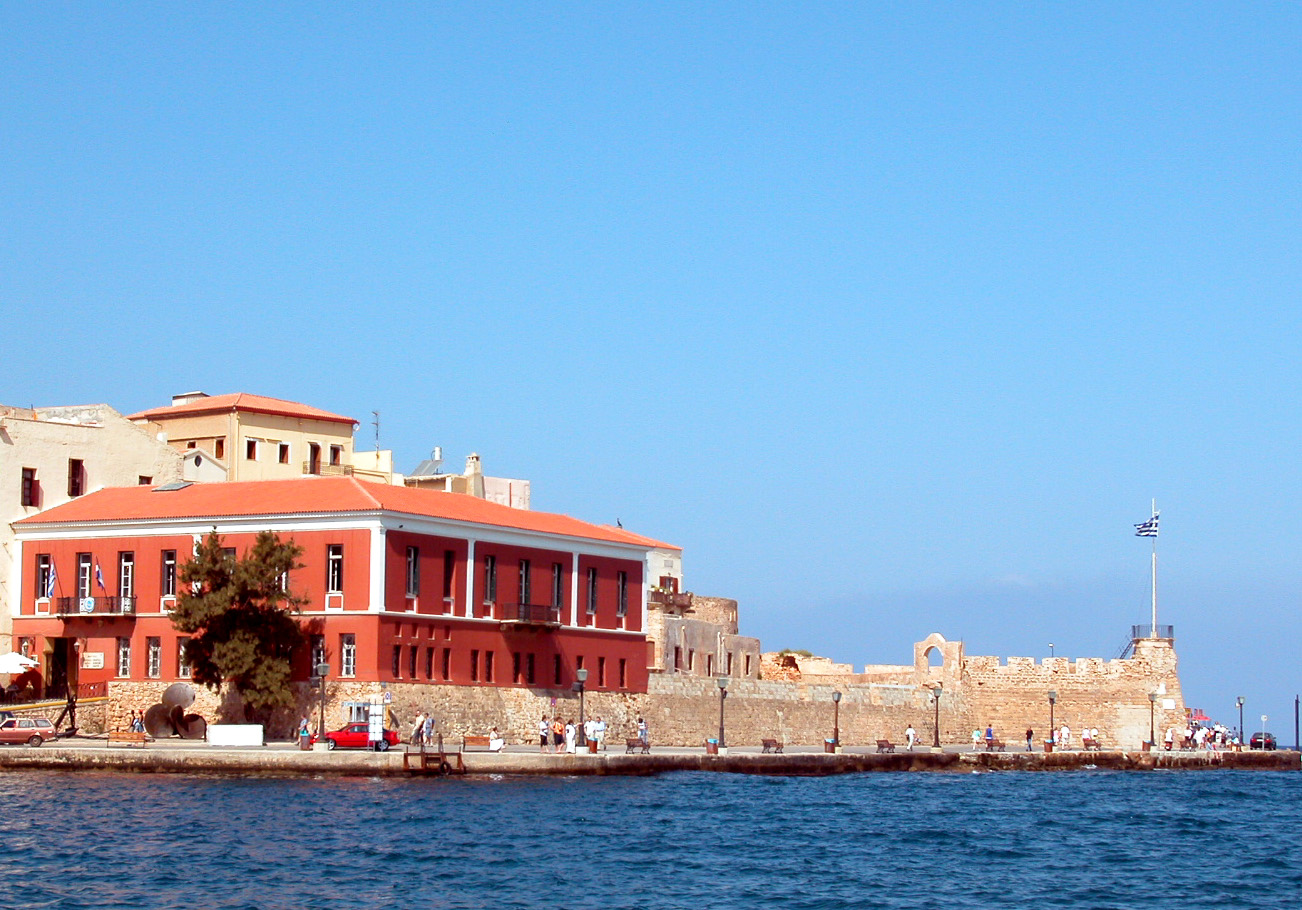
In 2004, we spent two weeks on Crete and loved it. These are photos of the harbour at Chania which is quite typical of the sea fronts in old Mediterranean towns and cities. You can see why walking beside the sea is so picturesque and interesting. And always there is the brilliant blue of the water and the intense blue of the sky! This can especially be seen if you right click on the image and open it in a new window so you can see the enlargement.
Crete, Thera (or Santorini) and Symi are our favourite Greek islands, and Sitia is one of the nicest things about Crete. We spent four days here, most of it on the beach, which was very good. It is easy to get around the island by bus, though we rented a car and drove to Kato Zakros in the east of the island. In 2004, when we were there, Crete had very good hotels and beaches, and to get away from hordes of tourists it was only necessary to leave the main cities. Sitia was the best place we found to do this, particularly if swimming is what you want to do. Everywhere on Crete, the people were great - very helpful and friendly.
We thoroughly enjoyed Phaestos, an ancient site on Crete, which we visited in 2004. Because there has been no reconstruction here as there has, for example, at Knossos, there were only the ruins themselves and the beauty of the site to work unimpeded upon the imagination. Phaestos sits on a hill with views overlooking the valley below. Another attraction is that these Minoan ruins are much older than the Greek and Roman sites we have visited, and yet they are relatively unknown, at least compared with Knossos.
When we visited Crete in 2004, Kalamaki had only recently become a resort. The Lonely Planet Guide to Crete recommended it as a lovely place off the beaten track. That was enough for us. We discovered in Chania, however, that there was no bus service beyond a point some distance away from our destination. Fortunately, after walking on a hot, dusty road hauling our suitcases for fifteen or twenty minutes, a nice gentleman stopped and drove us to our B&B. This was run by a wonderful Cretan family. We especially enjoyed the company of Rula, the daughter, who spoke excellent English.
For our first dinner, we went to a taverna on the beach, but soon after we ordered, there was a power outage. Without power, there was no way to cook, nor was there any light. We spent the time until food was finally served looking at this beautiful view of the sun setting over the sea.
We ate at this restaurant in Chania, Crete in 2004. The room was open to the sky and the tables were surrounded by old stones. There was also a band and singer of Greek songs - altogether a memorable experience.
This fresco, photographed in 2004, is so lovely! When you think about how old it is, it seems unbelievable that it has survived for such a long time or that people so long ago could have made something so beautiful. Minoan civilization was at its height from approximately 2700 BC to 1450 BC when it is thought to have been severely damaged by a volcanic eruption on the island of Thera.